
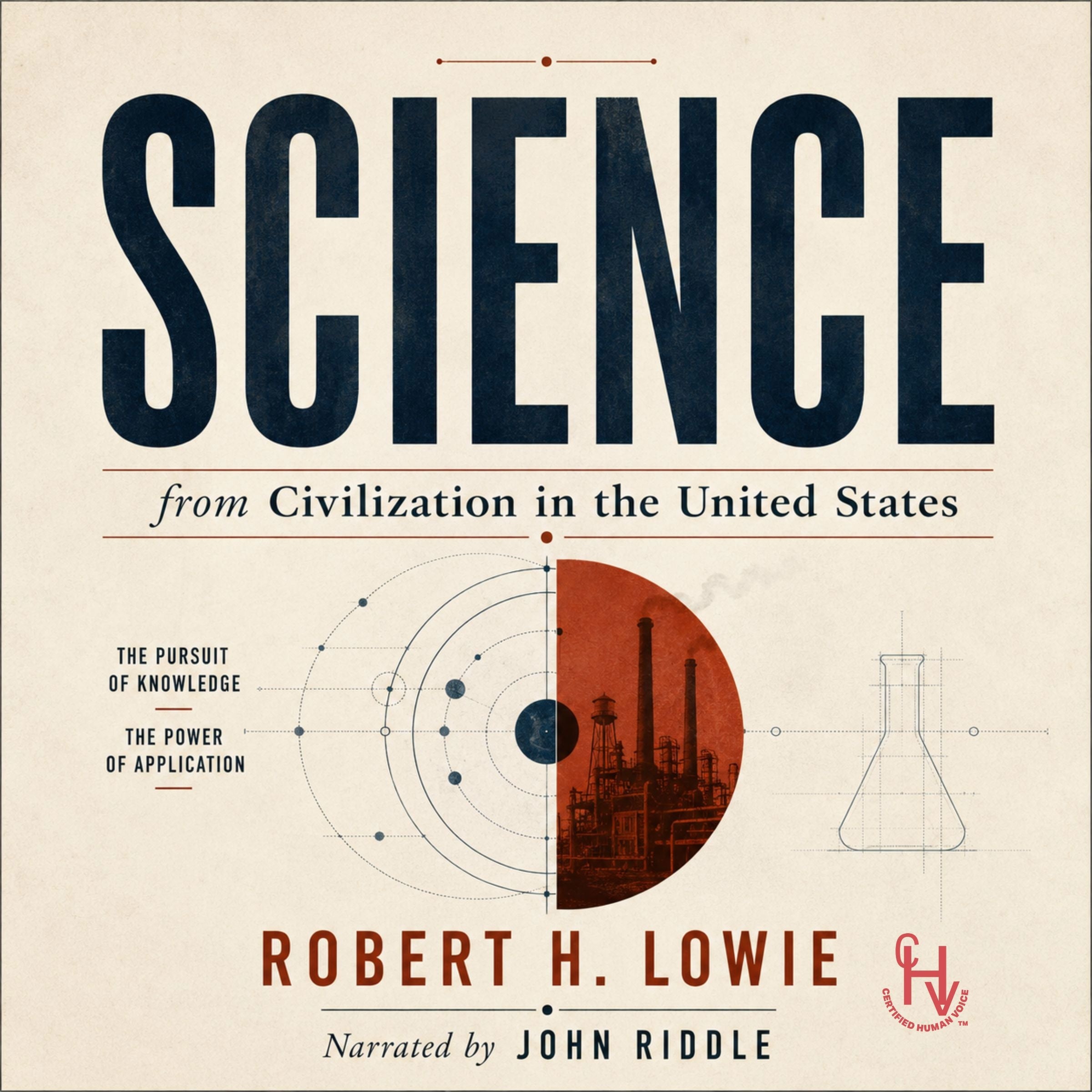
Science
Read by
John Riddle
Release:
08/01/2026
Runtime:
0h 35m
Unabridged
Quantity:

Monthly Membership
$12.99
Cancel anytime!
Memberships will renew every month
One credit every month on renewal
You can spend 1 credit every month to get an audiobook
What makes a nation scientific: its inventions, or its willingness to pursue knowledge without an immediate profit?
In this incisive essay from *Civilization in the United States*, anthropologist Robert H. Lowie examines America's complicated relationship with scientific achievement.
Lowie acknowledges the country's important researchers and practical accomplishments, but challenges the belief that commercial invention alone represents scientific greatness. America excels at applying discoveries to machines, products, and industry, he argues, while frequently neglecting the patient theoretical work on which those applications depend.
Pure scientists face limited funding, low professional status, exhausting teaching and administrative duties, and pressure to produce results that appeal to wealthy patrons or business-minded institutions. Universities often prize organization, efficiency, and publicity above the independent thinkers whose creativity gives scientific institutions their value.
Lowie also warns against intellectual conformity. Genuine discovery requires more than technical skill: it demands broad education, academic freedom, philosophical reflection, and what he calls "reasoned nonconformism"-the courage to question accepted authorities without abandoning evidence or disciplined thought.
Originally published in 1922, *Science* is a thoughtful critique of commercialism, institutional bureaucracy, and the cultural conditions required for lasting innovation.
Narrated by John Riddle.
In this incisive essay from *Civilization in the United States*, anthropologist Robert H. Lowie examines America's complicated relationship with scientific achievement.
Lowie acknowledges the country's important researchers and practical accomplishments, but challenges the belief that commercial invention alone represents scientific greatness. America excels at applying discoveries to machines, products, and industry, he argues, while frequently neglecting the patient theoretical work on which those applications depend.
Pure scientists face limited funding, low professional status, exhausting teaching and administrative duties, and pressure to produce results that appeal to wealthy patrons or business-minded institutions. Universities often prize organization, efficiency, and publicity above the independent thinkers whose creativity gives scientific institutions their value.
Lowie also warns against intellectual conformity. Genuine discovery requires more than technical skill: it demands broad education, academic freedom, philosophical reflection, and what he calls "reasoned nonconformism"-the courage to question accepted authorities without abandoning evidence or disciplined thought.
Originally published in 1922, *Science* is a thoughtful critique of commercialism, institutional bureaucracy, and the cultural conditions required for lasting innovation.
Narrated by John Riddle.
Release:
2026-08-01
Runtime:
0h 35m
Format:
audio
Weight:
0.0 lb
Language:
English
ISBN:
9798182600057
Publisher:
Author's Republic
Praise