
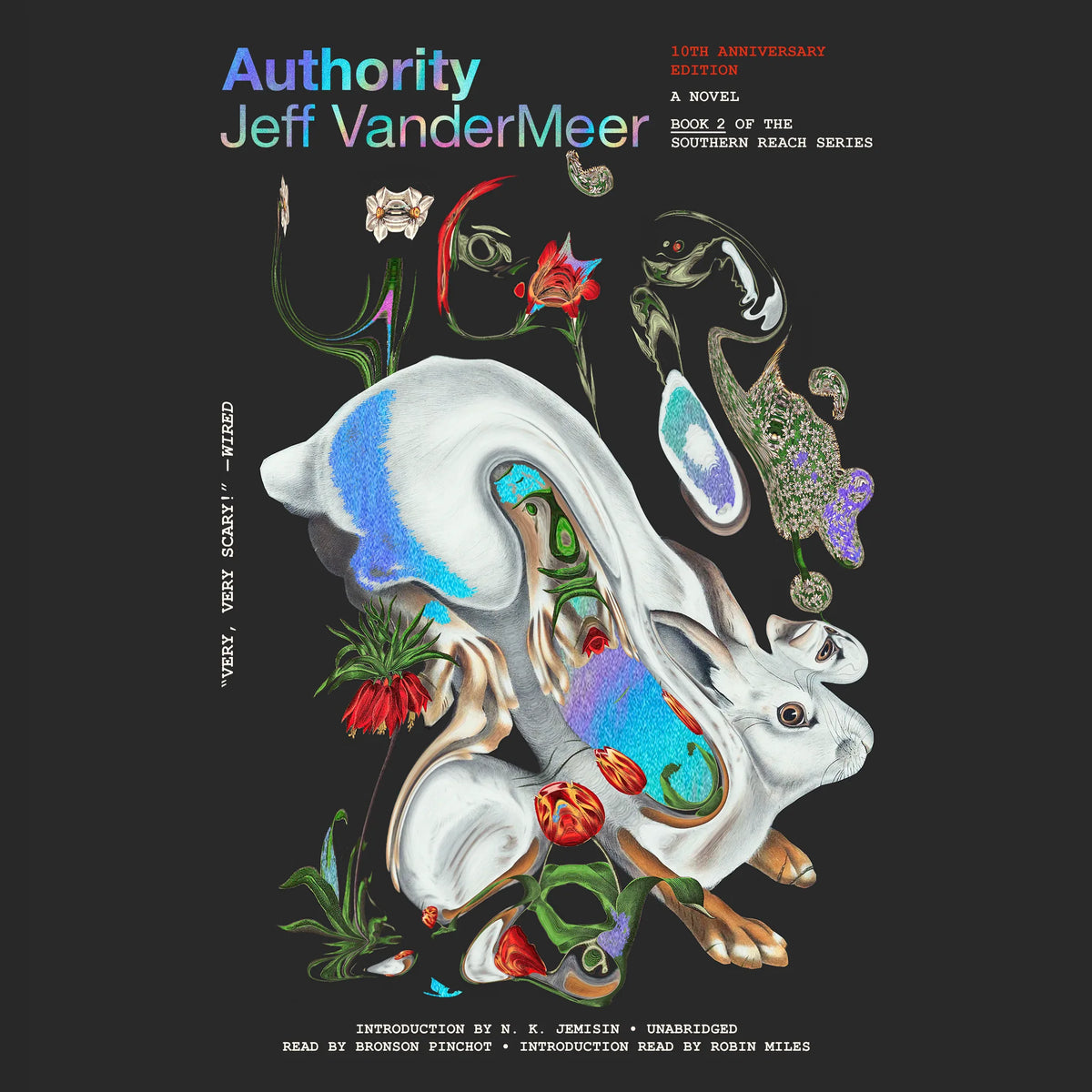

Another surreal expedition into uncanny terrain
In Authority, VanderMeer pivots from the first-person journal of the unnamed biologist (read by Carolyn McCormick) which introduced "Area X" in Annihilation to an exploration of a different, though as uncanny and surreal, terrain: the organization which sent her into "Area X" in the first place, the Southern Reach itself. We do see the biologist often in Authority, but it is through the eyes of agent/operative John Rodriguez (aka "Control"), newly appointed acting director of the Southern Reach, interrogating her after her reappearance along with the other survivors of the expedition depicted in Annihilation. Control finds offices in decay and disarray, a shrinking staff divided into factions loyal to the previous director and "lifers" who are in it for the weird science and/or have nowhere else, really, to go. Throughout, Control reports his progress and findings -- often couched -- to The Voice, a shrouded, mysterious figure known only as a (digitally masked) voice on the phone. The cast of characters here each have layers and motivations -- usually inscrutable -- of their own: Grace, the assistant director who believes the previous director is still alive; Cheney, the head of the science department; and fellow scientist Whitby, who frequently acts as Control's guide. I found the Southern Reach in Authority to act as both a metaphor for the many fragments of our own labyrinthine consciousnesses while also a rejection of such abstraction or disaggregation; an organization gone feral after decades of attempting to understand the incomprehensible, having stared too long into the abyss. Meanwhile Control's expedition into its hierarchies and storage rooms and film archives plays with and against reader expectations: again we must question the reliability of our narrator, of the purpose and use of evidence and rationality in the context of such a narrative in the first place. VanderMeer creates mystery, unease, and an escalation of the compulsion behind this series: what is "Area X"? Narrated by Bronson Pinchot for Blackstone Audio, the audiobook is, again, fantastic, cementing my feeling that Pinchot is one of the best narrators in the business (from non-fiction like How to Build an Android: The True Story of Philip K. Dick’s Robotic Resurrection to the wide-ranging accents of Tim Powers’ On Stranger Tides and Last Call, to Ray Bradbury’s The Halloween Tree). Pinchot's characterizations of Grace (annoyed, Southern, mistrustful of Control), Cheney (bombastic, seemingly oblivious), Whitby (hesitant, waffling, couching), linguist Jessica Hsyu, and indeed "Ghost Bird", the biologist from Annihilation are all spot-on. On the latter it's really, really interesting to get a third-person perspective on the biologist, who remains a bit flat in affect but with something else waiting underneath. Pinchot also does something a bit subtle in the first chapters: he starts voicing Control's dialogue with a soft Hispanic accent, which slowly disappears until being read with a neutral accent. Is his identity so quickly swallowed up by the Southern Reach? It's just one more of the layers-within-layers that draws us ever deeper in. As the sense of unease, of wrongness, of looking where we should not be looking grows (to me drawing connections between the Southern Reach of Authority and the Coburn National Laboratory and Observatory in Robert Jackson Bennett's American Elsewhere), Pinchot's narration matches it, tension for tension, finally bursting apart like a puffball mushroom and letting the ideas aloft like spores across the terroir of the transformed landscapes, closing after a novel with a more thriller pacing of half-hour chapters with an extended last chapter three times that length which is impossible to put down. In the end, Authority like Annihilation stands alone; one can read the other without having read (or having to read) the other; reading Authority without Annihilation may if anything add to the mysteriousness at hand, though of course each offers additional layers of context for the other. Also: both novels offer by their final pages a certain closure to dramatic arcs of decision and action, while of course inviting (if not compelling!) further expeditions.